
The bottom line
- Waste companies are greenwashing disposal. Landfills and incinerators are being rebranded as part of the clean energy transition, despite their environmental impacts.
- Generating energy doesn’t eliminate pollution. Capturing landfill methane and burning trash for electricity under the guise of “renewable natural gas” doesn’t eliminate harmful emissions that threaten public health.
- Reducing waste is the real solution. Zero Waste policies prevent pollution, conserve resources, and reduce our reliance on landfills and incinerators.
The problem with landfills and incinerators
Landfills and incinerators do not eliminate the toxicity of waste. They concentrate it and create new pathways for pollution. In the United States, landfills are the third largest human-made source of methane – a greenhouse gas 28 times more powerful than carbon dioxide. The main culprit of these emissions is organic waste. When food scraps, paper, yard waste, and other organic materials are buried in a landfill, they break down without oxygen to produce methane. In fact, food waste alone is responsible for an estimated 58% of all landfill methane emissions.
Beyond methane, landfills release a range of harmful air pollutants, including benzene and hydrogen sulfide, that can contribute to smog, cause unpleasant odors and respiratory irritation, and contain known carcinogens, like PFAS commonly referred to as “forever chemicals,” that pose potential health risks to nearby communities. Landfills also contaminate water and soil when landfill leachate, a toxic liquid formed when water from rain and snow mixes with waste. Containing a mix of chemical and biological pollutants, this liquid consolidates at the bottom of the landfill. While there are systems to capture leachate, they can fail – causing this toxic liquid to seep out into the environment where it contaminates surface water, groundwater, and soil.
Incinerators, on the other hand, burn waste like plastics, rubbers, metals, and any household items that end up in the trash. This process releases significant amounts of carbon dioxide, along with pollutants like nitrogen oxide, particulate matter, heavy metals, and other hazardous substances. Just as logs in a fireplace leave behind ash when burned, so too does waste. But the large quantities of ash leftover from incinerating trash are toxic – containing many chemicals and hazardous substances. All this ash gets sent to a landfill for disposal. In 2018, an estimated 12% of the 292 million tons of waste produced by cities and towns in the U.S. was sent to incinerators.
Despite these well-documented impacts, both industries have spent decades trying to portray landfills and incinerators as environmental solutions. More recently, they’ve found a particularly powerful way to do that: calling the energy produced from our waste “renewable.”
Landfill gas-to-energy doesn’t make landfills clean
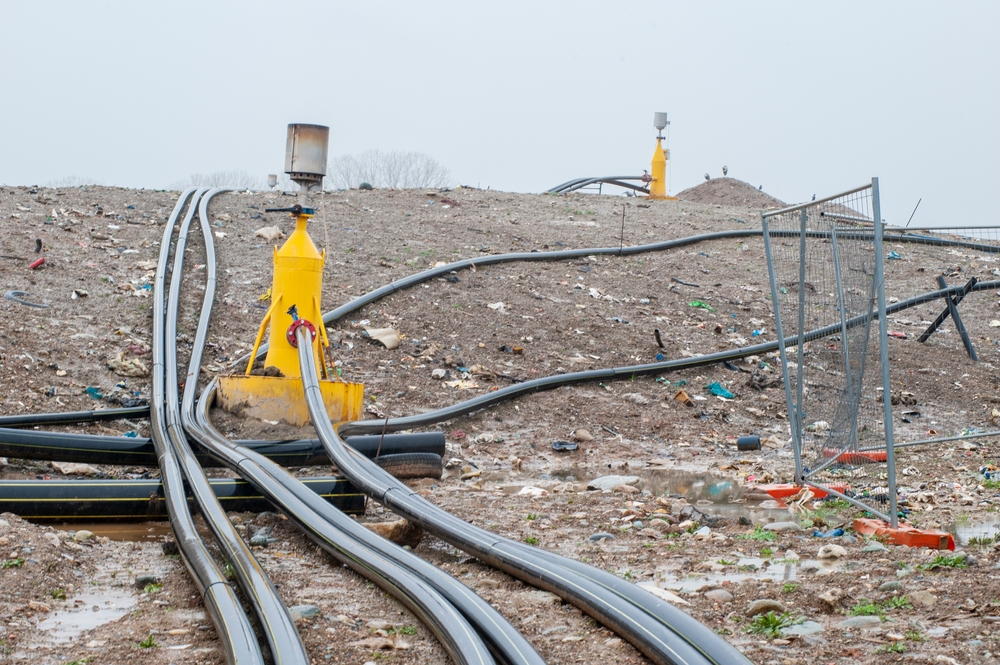
Landfill gas-to-energy systems attempt to capture some of the methane generated inside of a landfill and burn it to produce electricity or heat. The landfill operators collecting methane then market it as “renewable natural gas.” While capturing methane can reduce some emissions from waste that has been buried, it does not make landfilling clean or safe.
Even the best landfill gas collection systems fail to capture all methane emissions. Organic waste breaks down quickly, meaning much of the methane can escape before gas-collection equipment is installed or expanded. Even after installation, gas can leak through cracks in pipelines, poorly maintained wells, and faulty landfill covers. Further, while methane makes up around 50% of landfill gas emissions, it isn’t the only concern. Landfill gas also contains harmful chemicals such as benzene, toluene, vinyl chloride, trichloroethylene, and PFAS.
Building and expanding collection systems will not prevent landfill pollution. The answer is to reduce the amount of waste thrown out in the first place. That means enacting food-waste prevention laws that emphasize food donation, composting, and other forms of organics recycling. According to the U.S. Environmental Protection Agency (EPA), organic materials make up half of the waste generated by the country’s cities and towns. Around 50% of this waste is sent to landfills. That is why implementing policies that keep food scraps and other organic materials out of landfills are essential to reduce waste sent to landfills.
Why waste-to-energy incineration isn’t renewable
Incinerator companies also claim their facilities are “clean” or “renewable” by marketing the technology as “waste-to-energy.” The most common waste-to-energy facilities are known as “mass-burn.” They burn trash to boil water, producing steam that powers a turbine to generate electricity. This process is often promoted as a solution to eliminate trash while producing valuable energy. But incineration does not make waste disappear. It converts trash into air pollution, greenhouse gases, and ash.
What incineration companies fail to mention in their “waste-to-energy” marketing campaigns is that burning trash means burning fossil fuels hidden within. Trash is a complex mixture of organic waste that naturally breaks down and human-made waste that doesn’t. This includes products originating from fossil fuels, like plastics, synthetic textiles, and rubber. When burned in an incinerator, plastics release carbon dioxide and toxic chemicals into the environment – contributing to climate damage and air pollution. In fact, waste incineration emits more carbon dioxide per unit of energy than coal. So, while waste incineration can generate some energy, it doesn’t mean that energy is clean.
Expensive to build and operate, “waste-to-energy” facilities require a steady stream of trash to function and produce electricity. This creates a demand for more trash – directly undermining efforts to reduce waste. Further, because these facilities destroy the materials burned, there are no opportunities to recover natural resources for reuse or recycling.
Several states classify “waste-to-energy” as renewable energy under their renewable portfolio standards. These policies require energy producers to get their electricity from renewable sources. Yet some states allow electricity generated by trash-burning facilities to count towards those goals, which is highly problematic. Only emission-free resources, like wind and solar, should count towards renewable energy.
The real solution is creating less waste
Communities across the country are working to advance Zero Waste policies that prevent waste and keep valuable materials circulating, rather than burying or burning them.
Separating food scraps, yard trimmings, and other organic materials keeps these resources out of landfills, where they generate methane. Composting turns them into a natural fertilizer that supports soil health and reduces the need for synthetic fertilizers. These programs can have significant impacts on emissions, with one study finding that composting results in 38% to 84% fewer greenhouse gas emissions than landfilling. Single-use plastic bans can help eliminate needless and unrecyclable waste that are destined to end up in landfills or incinerators. Policies like Bottle Bills can help capture highly recyclable materials, ensuring they are used to make new products, rather than being burned or buried.
Capturing methane from a landfill or generating electricity while burning trash doesn’t transform toxic waste into clean energy. These technologies rely on a constant stream of waste that damages our climate and environment, harms public health, and depletes natural resources. Rather than managing the consequences of disposal through toxic waste-to-energy systems, Zero Waste policies can build systems that create less pollution and protect our communities.
What the waste and fossil fuel industries won’t tell you about burning trash
Burning trash is an expensive scam. Waste companies claim they use technology that generates “renewable energy,” or reuses plastic in “innovative” ways. But that’s not true.
Compost like our climate depends on it (because it does)
Turning food scraps and other organic waste into clean, healthy compost helps prevent climate-damaging emissions from landfills and incinerators.